3 types of VoIP technology as they relate to businesses
1. IP Telephones
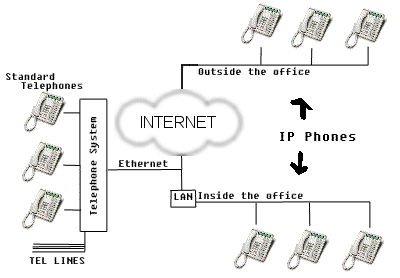
IP Telephones allow you to use any LAN/WAN/INTERNET connection to connect to your phone system. LAN connections are those network locations within your office. WAN connections include connecting through linked multi-office systems. Internet connections include any hi-speed internet connection anywhere in the world.
LAN (Local Area Network)
When setup for your LAN, you can place your phone at any computer location in your office. This can be a bit of a waste, because a conventional phone can do the same thing for a fraction of the price.
WAN (Wide Area Network)
IP Phones on your WAN (i.e. a satellite office with a linked computer network to the main office) is pretty cost effective for very small applications. However, once you go above a handful of IP phones in the satellite office, you will probably have to increase your internet bandwidth in both locations, which means a bigger monthly bill. Bigger applications have a better solution: "Networking Phone Systems" (See #2 below). Also consider that if that satellite office wishes to make an outside call, that call will use the main office's phone lines to call out.
INTERNET
When using the internet, you can place your phone at any external location with high-speed internet. It is easy to see the advantage of being able to travel around the world, plug in your phone, and talk to your main office via intercom and place telephone calls from your main office.
CORTUM Communications offers this technology. It can be added to our current line of telephone systems. At Affordable Telephone Systems, we strongly believe that having a conventional phone system with IP phones added as an option is the best balance of price and reliability.
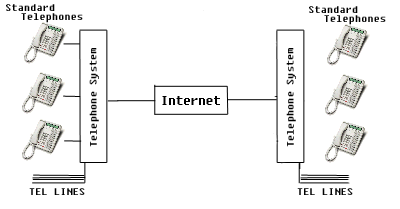
For years, telecommunications manufacturers have found ways to network
multiple phone systems together. The basic technology is not new. Only recently
has VoIP been used to extend the distances and reduce the costs. In the same
way Wide Area Networks (WAN) link computer servers together, VoIP can be used
to link phone systems together. For example, a main office is located in
- A single, centralized
voicemail system is located in SD. It is not necessary to have another one
in the
- Employees can intercom back
and forth from SD and
- SD office can transfer
outside calls to
- Both SD and
The only disadvantage is price, but in most cases, this can be fully offset by the advantages listed above.
CORTUM Communications offers this technology. It can be added to our current line of telephone systems. It is recommended for any company that has multiple sites (or even multiple buildings on a single site).
3. VoIP Phone Lines (SIP Trunks)
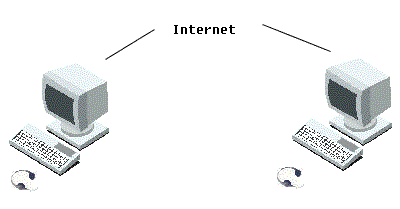
SIP Trunks (SIP stands for Session Initiation Protocol) are lines delivered to you using your internet connection. All providers offer this type of trunk as an option. In many cases, the providers use the internet to deliver your phone lines so they can “bundle” your services together under the assumption that you will save money. There are many providers to choose from.
With VoIP lines, sometimes you
compromise reliability
We would love to tell you that VoIP lines are just as reliable as regular copper lines, but sometimes that is just not true (you won’t hear this from very many telecommunication companies). You should realize that because you are getting your lines through your internet connection, when your internet goes down so do all your phone lines. Copper lines are delivered to you on individual wires, so unless someone or something severs all the wires, you usually have problems with one line at a time and you can still do business. Unfortunaltely, copper lines are being phased out of the telecommunications industry. They are likely unavailable to you, or often prohibitively expensive.
SIP Trunking in your Phone System
If you order SIP Trunks and have them registered (connected) directly to your phone system, you get two important features: Caller ID and Direct Inward Dialing (DID). You know what Caller ID is, but what is DID? If you have ever worked at a large company with a big phone system and everybody seems to have private lines (individual phone numbers for each employee), this is done most effectively with DID. When a telephone number that your company pays for is called, the call comes into the phone system on any available trunk, then the phone system reads the number dialed and routes it accordingly. This means that all the lines on your system are not associated with their own phone numbers, they all function as general trunks, ready to accept a call to any phone number your company pays for.
 Back to
VoIP
Over to Products Page